
.png)
Closinglock is a leading escrow management platform that has protected more than 1.5 million home closings.
As the company grew, valuable customer information became distributed across Salesforce, HubSpot, Outreach, Highspot, Jira, support platforms, Customer Success notes, and other internal systems. Each platform held part of the customer story, but no team could see the complete picture.
Product teams wanted to understand customer feedback and prioritize the roadmap. Customer Success needed better visibility into health and retention signals. Sales wanted to improve coaching and messaging. Analytics and operations teams needed a more holistic view of the business.
With Riley, Closinglock connected its structured and unstructured customer data into a shared intelligence layer. Work that once required weeks of exporting, cleaning, and standardizing data each quarter can now be completed in minutes, with insights available continuously rather than only after a manual reporting cycle.


Closinglock had no shortage of customer data. The challenge was connecting it.
Salesforce contained CRM information. Support issues lived in a ticketing platform. Product requests were tracked in Jira. Customer Success teams documented customer conversations separately. Sales and marketing teams worked from additional systems such as Outreach and Highspot.
The data existed, but understanding what it meant required extensive manual work.
To analyze historical customer feedback, teams had to download information from multiple systems, clean and standardize it, reconcile identifiers, and then interpret both quantitative and qualitative signals. Even when generative AI was used, it lacked Closinglock’s company context and could easily misinterpret internal language, acronyms, or customer-specific details.
For the R&D organization alone, consolidating product-related requests consumed several weeks every quarter.
The fragmented environment also created operational blind spots. A customer might have a growing number of support tickets, an unresolved feature request in Jira, and concerns documented by Customer Success—but no single team could easily connect those signals.
Closinglock needed more than a place to store or summarize data. It needed a way to understand how signals across systems related to one another.
Closinglock evaluated other AI vendors before selecting Riley.
Many of the alternatives could organize information or summarize individual datasets. However, Closinglock wanted to go further: connecting customer feedback, operational activity, qualitative context, and business data to reveal patterns that would otherwise remain hidden.
Riley connected information across Closinglock’s customer ecosystem and created a unified intelligence layer grounded in the company’s own data and terminology.
Instead of repeatedly exporting data or searching across separate systems, teams could use Riley to investigate customer questions, monitor trends, and bring trusted customer context into their existing AI workflows.
One of the most valuable early discoveries came from connecting information that had previously been managed by three separate teams.
The support organization responded quickly when customers reported issues, but its tickets lived in a dedicated support platform. When an issue led to a feature request or product modification, that request moved into Jira. Customer Success separately tracked what individual customers were waiting for and where relationships might be experiencing friction.
Each team was doing its job, but no one had continuous visibility across all three systems.
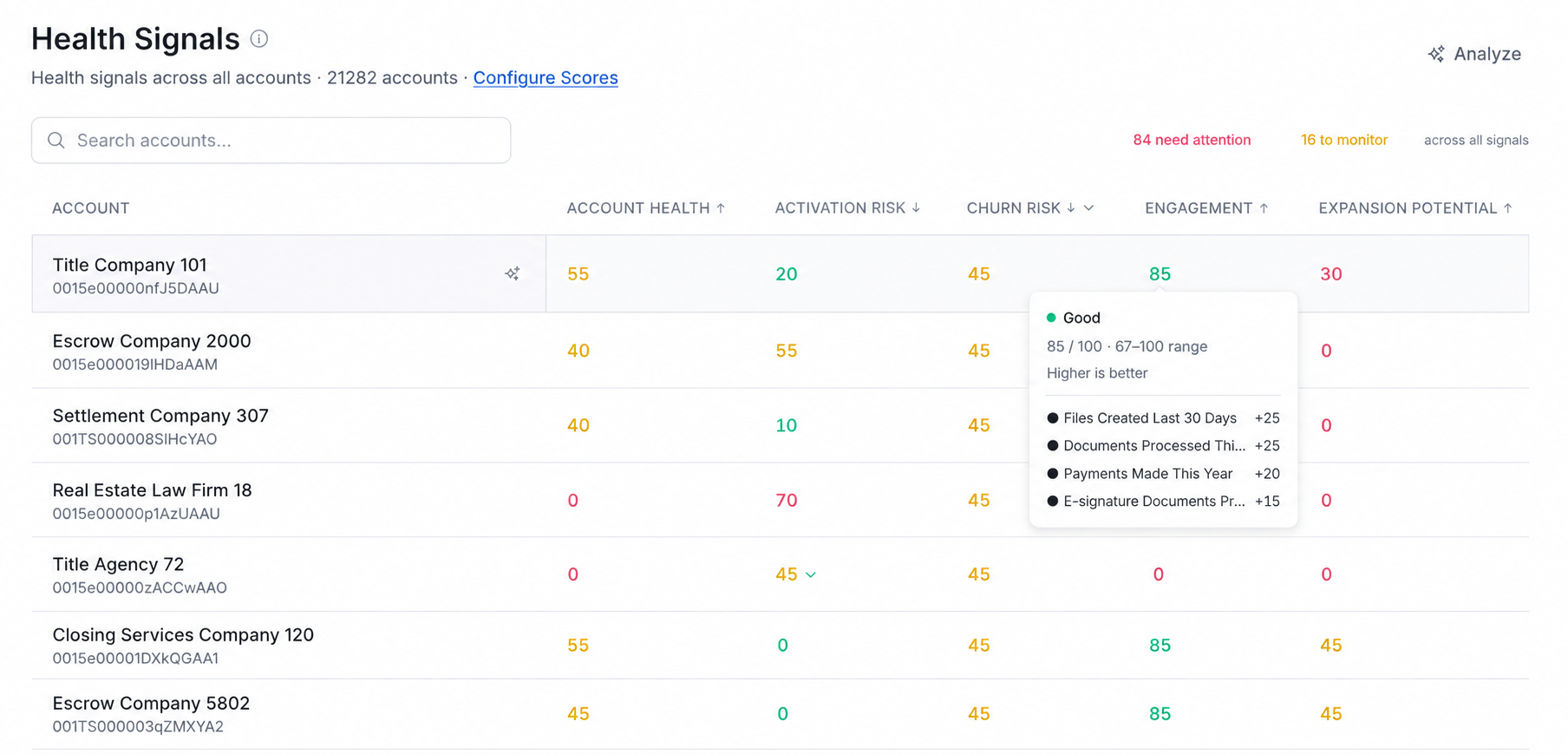
Once Riley connected the data, Closinglock could identify when multiple signals pointed to the same emerging customer risk. For example, Riley could highlight that support activity was increasing, an important request remained unresolved, and related concerns were appearing in Customer Success conversations.
This gave teams a more complete explanation of customer health—not simply a score, but the evidence behind it.
Closinglock is now working to incorporate Riley’s qualitative customer sentiment and connected signals into its broader customer health model.
Before Riley, customer analysis depended heavily on periodic reporting exercises. Teams could spend weeks preparing data before they could begin answering business questions.
Riley changed that operating model.
Historical requests that previously required extensive manual consolidation can now be analyzed in minutes. New information is continuously incorporated, giving teams access to current customer signals instead of relying on a static quarterly snapshot.
Riley’s trending capabilities also allow teams to monitor how customer needs and risks change over time. Rather than producing a one-time report, Closinglock can see when an issue is growing, when a theme begins to spike, or when a customer signal requires closer attention.
This helps teams move from retrospective analysis toward earlier, more proactive action.
Riley initially entered Closinglock through a Voice of Customer and product-planning use case. It quickly expanded as other teams recognized the value of working from the same connected customer context.
Product teams use Riley to analyze feedback on existing features, understand customer and prospect pain points, and identify opportunities for future roadmap investment.
Access to both historical feedback and current customer conversations helps the team validate decisions more quickly and reduce the risk of investing in the wrong priorities.
Customer Success teams use Riley to better understand churn and retention signals, monitor customer sentiment, and identify issues that may be beginning to surface across support interactions and unresolved requests.
Closinglock believes this earlier visibility will help teams intervene sooner and contribute to long-term churn reduction. The company is also beginning to incorporate these insights into customer playbooks and health scoring.
Sales teams use Riley to evaluate conversations against examples of what strong performance looks like. Managers can identify opportunities to improve positioning, messaging, and rep coaching using evidence from real customer interactions.
Product Marketing uses customer conversations to understand which messages are resonating, where positioning needs to evolve, and how customer needs are changing.
Operations and analytics teams use Riley to examine data through a more holistic lens. Closinglock is also exploring additional RevOps use cases, including forecasting and broader business trending.
Riley has become sufficiently central that Closinglock’s IT leadership now directs employees to Riley when they need insights from connected company databases.
Closinglock has also integrated Riley into the AI tools employees already use.
Teams can query Riley’s connected customer intelligence through Claude, enabling them to use generative AI while grounding their work in a common source of company data.
This prevents each team from bringing a different, incomplete dataset into its analysis. Product, revenue, operations, and other functions can work with the same underlying customer context—even when the final work happens in another AI interface.
The result is not simply broader access to AI. It is more consistent decision-making across the organization.
.png)
Within its first year with Riley, Closinglock achieved several meaningful operational improvements:
The long-term impact extends beyond productivity. Closinglock now has a stronger foundation for roadmap planning, proactive customer health management, retention initiatives, sales coaching, and revenue operations.
For Closinglock, Riley’s value has come not only from the technology, but also from the partnership behind it.
The Riley team worked closely with Closinglock throughout adoption, helping teams refine queries, explore new use cases, and adapt the platform as the company’s needs evolved.
That hands-on approach helped Closinglock move beyond its original Voice of Customer use case and discover opportunities across customer health, sales enablement, product strategy, analytics, and RevOps.
For Closinglock, Riley has become more than another tool in its technology stack. It is the intelligence layer connecting the company’s customer ecosystem—and giving every team a clearer, more complete understanding of the customer.