
The Customer Insights Trap: Are We All Building the Same Product?
I just returned from a retreat with company leaders, and one theme came up repeatedly: everyone wants to better understand their customers, believing it’s the only way to build winning strategies and stand out from competitors. Yet, nearly all of them shared the same frustration: despite thinking they understand their customers, they’re still seeing declining engagement, rising churn, lost deals, and growing dissatisfaction. So, what’s causing the gap?
The Typical Stack for Voice of the Customer
This is the typical stack that companies use to help them capture and understand customer feedback.
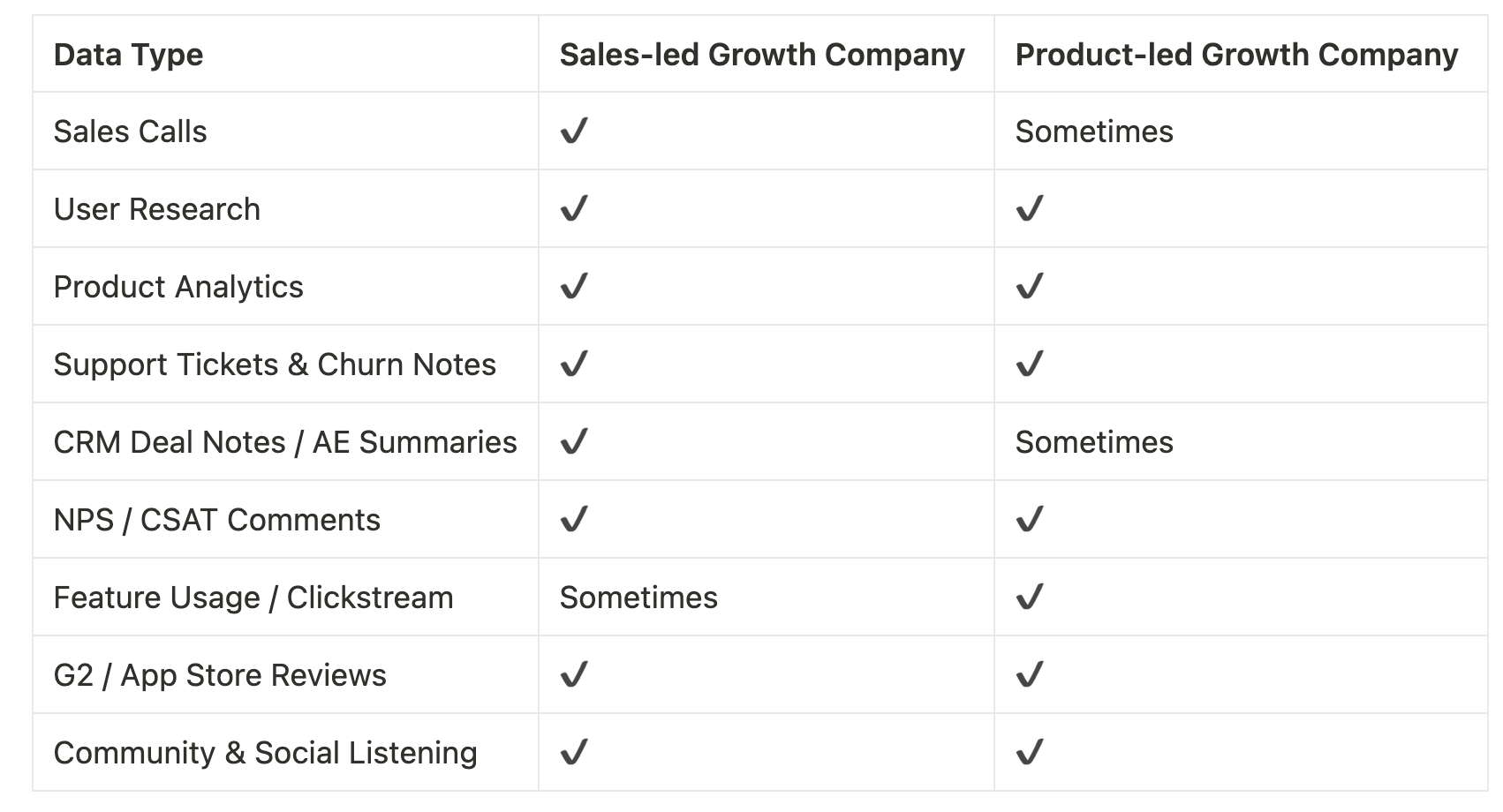
Most teams rely on analysis as a rear-view mirror to evaluate something.
- Closed-lost reviews happen only after the deal is gone.
- User-research reports land weeks after the feature is scoped.#
- GPT queries churn out “competitive insights” that everyone else is also generating in seconds
It’s as if the world of insights is inherently doomed to be retroactive. The tools we use are designed to summarize what’s already happened, but they fall short when it comes to signaling, with confidence, what deserves our attention right now.
It’s like driving with a GPS that only tells you where you’ve been, not where traffic is building or when there’s a faster route ahead.
Why is it so hard to find signals?
Signals = volume × consistency × context
- Massive volume matters. A GPS like Waze can reroute you instantly because it crunches live speed and location data from ≈ 151 million drivers every month.
- Most companies lack this depth. In a Salesforce survey of 9,800 executives, 41 % said their data is too complex or inaccessible and 67 % still don’t use data to set prices—so decisions rely on snapshots, not streams.
A single survey, interview, or query might tell you what happened once, but without broader context or repetition, it often ends up becoming just noise. True signals emerge when you can triangulate across time, tools, and teams. Without that, you’re making decisions with partial visibility.
The Solution: A Customer Intelligence Engine
To close this gap, what companies need isn’t another retroactive report but a customer intelligence engine. This engine should not just collect feedback but should also triangulate it across sales calls, surveys, CRM notes, and behavioral data to go beyond static summaries and actually surface living signals.A smart and helpful customer intelligence engine should have the following characteristics:
**Step 1: Connect Signals Across Teams and Tools **
- Bring in feedback from sales calls, support tickets, surveys, CRM, and product analytics
- To avoid siloed insights, bring all of your data into a single pipeline—structured enough to compare, but flexible enough to include qualitative nuance.
**Step 2: Apply Pattern Detection Across Sources **
- Use models to cluster themes and detect repeat signals across sales, support, research, and analytics
- Score each insight based on frequency, recency, and cross-source consistency to ensure accuracy and replicability
**Step 3: Deliver Ranked, Decision-Ready Insights **
- Automatically rank top issues and emerging trends
- Highlight direct quotes and themes your team can act on immediately
- Continuously refine what gets highlighted by learning from what’s been acted on, ignored, or changed over time
Just like Waze reroutes based on live traffic, a true intelligence engine tells you what’s rising, shifting, or breaking down right now. It gives companies an always-on pulse of customer needs, so decisions are made with foresight. Until teams shift from snapshots to systems, they’ll keep mistaking noise for insight and watching churn rise while thinking they’re customer-led.
That gap between knowing your customer and acting on what matter is not a research problem, it’s a systems problem. Riley builds and maintains your customer intelligence layer for you, tailored to your business, your data, and how your customers actually behave. Not just surfacing what’s loud, but detecting the signals that are shifting—before they turn into churn, missed revenue, or the wrong roadmap.
About the author
Claudia is the CEO & Co-Founder of Riley AI. Prior to founding Riley AI, Claudia led product, research, and data science teams across the Enterprise and Financial Technology space. Her product strategies led to a $5B total valuation, a successful international acquisition, and scaled organizations to multi-million dollars in revenue. Claudia is passionate about making data-driven strategies collaborative and accessible to every single organization.Claudia completed her MBA and Bachelor degrees at the University of California, Berkeley.